
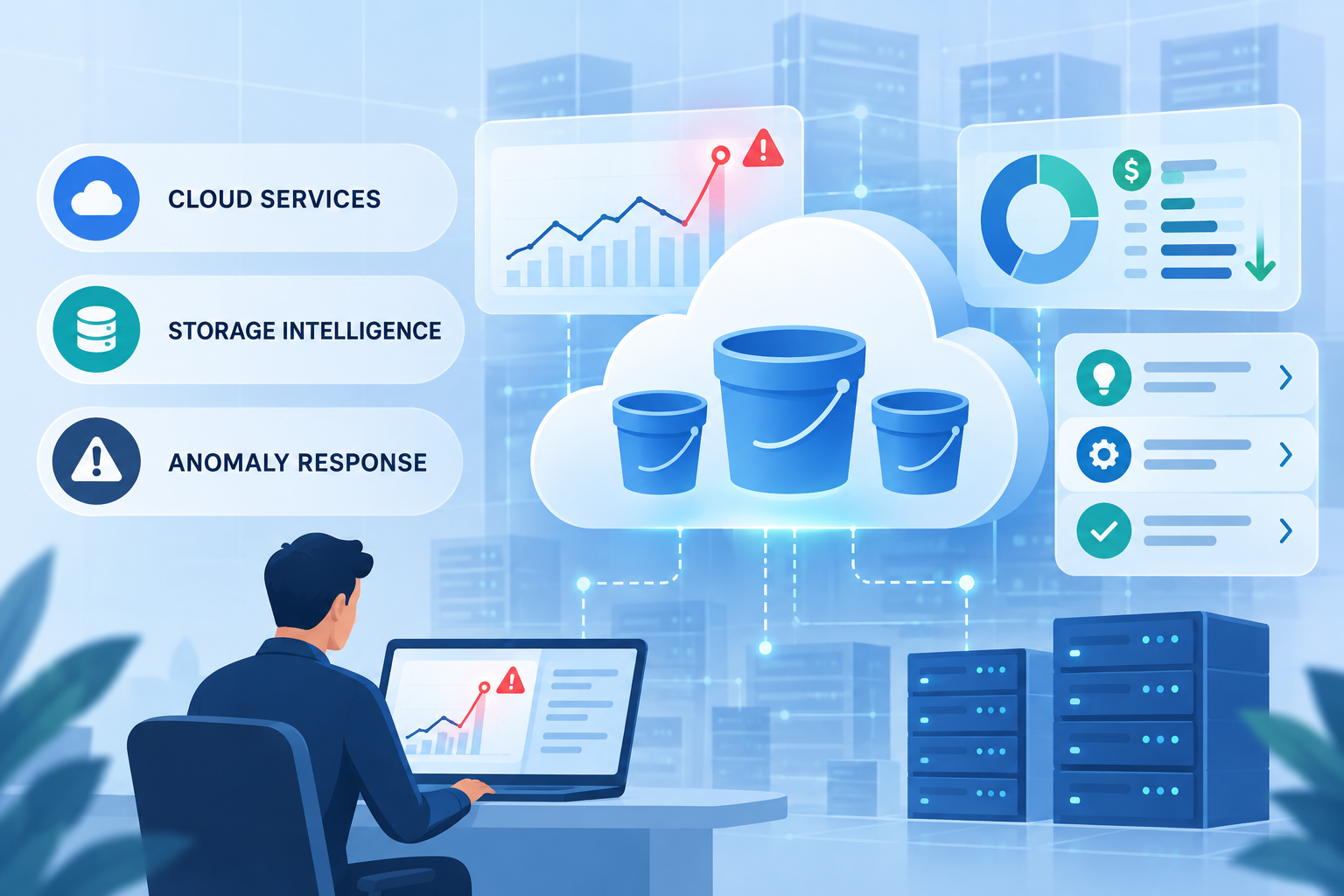
Cloud storage rarely fails with one dramatic signal. Cost and performance problems accumulate through operation surges, cross-region egress, rate limiting, abandoned buckets, and capacity growth that exceeds the expected trend. Traditional dashboards show the numbers, but they often leave teams to discover which project, bucket, prefix, or identity caused the change.
Google Cloud’s Storage Intelligence Advisor is now generally available and provides curated metrics, anomaly detection, and recommended actions. The more important lesson is broader than one product: storage visibility creates value only when it is connected to an owned response loop.
Start with the anomaly categories
Useful storage signals map to different operational questions. A spike in Class A or B operations may indicate an application loop or a workload touching archived data. Cross-region egress can reveal a placement mistake or a new consumer. A rise in 429 errors points to request concentration or missing backoff. Storage growth above trend can indicate retention drift, duplicated outputs, or a legitimate business change.
Do not route every anomaly to the same queue. Attach a likely owner, severity, cost or reliability impact, and first diagnostic step to each category. The goal is to shorten the distance between detection and a safe decision.
Drill down without broad access
Investigations need organization, project, bucket, prefix, and principal context. Grant the permissions required to view findings without automatically granting rights to modify every storage resource. Separate diagnosis from remediation where the action could delete, relocate, or change retention for data.
Historical context matters. A short spike may be normal for a monthly close, while the same pattern on an ordinary day is suspicious. Compare against business calendars, deployments, data migrations, and known batch windows.
Build a response playbook
For each finding, define validation, containment, remediation, and verification. An egress spike playbook might confirm the destination region and initiating identity, stop an unintended transfer, redesign data placement, and verify that cost and traffic return to baseline. A rate-limit playbook might identify hot prefixes, add backoff, redistribute request patterns, and confirm error reduction.
Recommendations should remain reviewable. Automation can open an incident, enrich it with evidence, and propose a change. Destructive lifecycle or location changes deserve approval and a rollback plan.
Connect storage intelligence to FinOps and security
The same anomaly can have cost, reliability, and security implications. Unexpected egress might be inefficient architecture or unauthorized access. A surge in object reads might reflect product growth or credential misuse. Route findings across disciplines without creating duplicate incidents.
Use unit measures such as storage cost per customer, operation cost per processed document, or egress per analytic workload. This distinguishes healthy growth from deteriorating efficiency and gives product teams a metric they can influence.
Operationalize the review cadence
Review high-severity findings continuously and trend-level findings weekly. Track time to owner, time to explanation, time to remediation, avoided cost, repeated causes, and false positives. Feed recurring issues into architecture standards: region-selection rules, lifecycle templates, retry libraries, and required labels.
Storage insights datasets can provide queryable metadata and activity for deeper analysis. Use that capability to validate recommendations, build organization-specific controls, and measure whether remediation persists.
The takeaway
An advisor is most useful as the front end of a closed operational loop. Detect anomalies, identify the responsible resource and identity, apply a governed playbook, verify the outcome, and improve the platform standard. That turns storage monitoring from a reporting exercise into continuous cloud hygiene.
Sources
- Google Cloud: What’s new with Google Cloud
- Google Cloud documentation: View Storage Intelligence Advisor
- Google Cloud documentation: Storage Intelligence overview
Build it with Cogniquaint experts
Cogniquaint’s cloud experts work alongside operations, security, and FinOps teams to baseline storage estates, define anomaly playbooks, automate evidence collection, and implement governance that converts findings into verified improvements.
Work with Cogniquaint
Ready to elevate your operations with AI-powered insights?
Get in touch with us to build your next intelligent solution.