
Many agent prototypes assume a request begins and ends inside one application process. Production work is messier. A coding investigation may run for hours, a document review may require specialist handoffs, and an agent may need files, tools, durable context, approvals, and progress events. At that point, the agent loop becomes infrastructure.
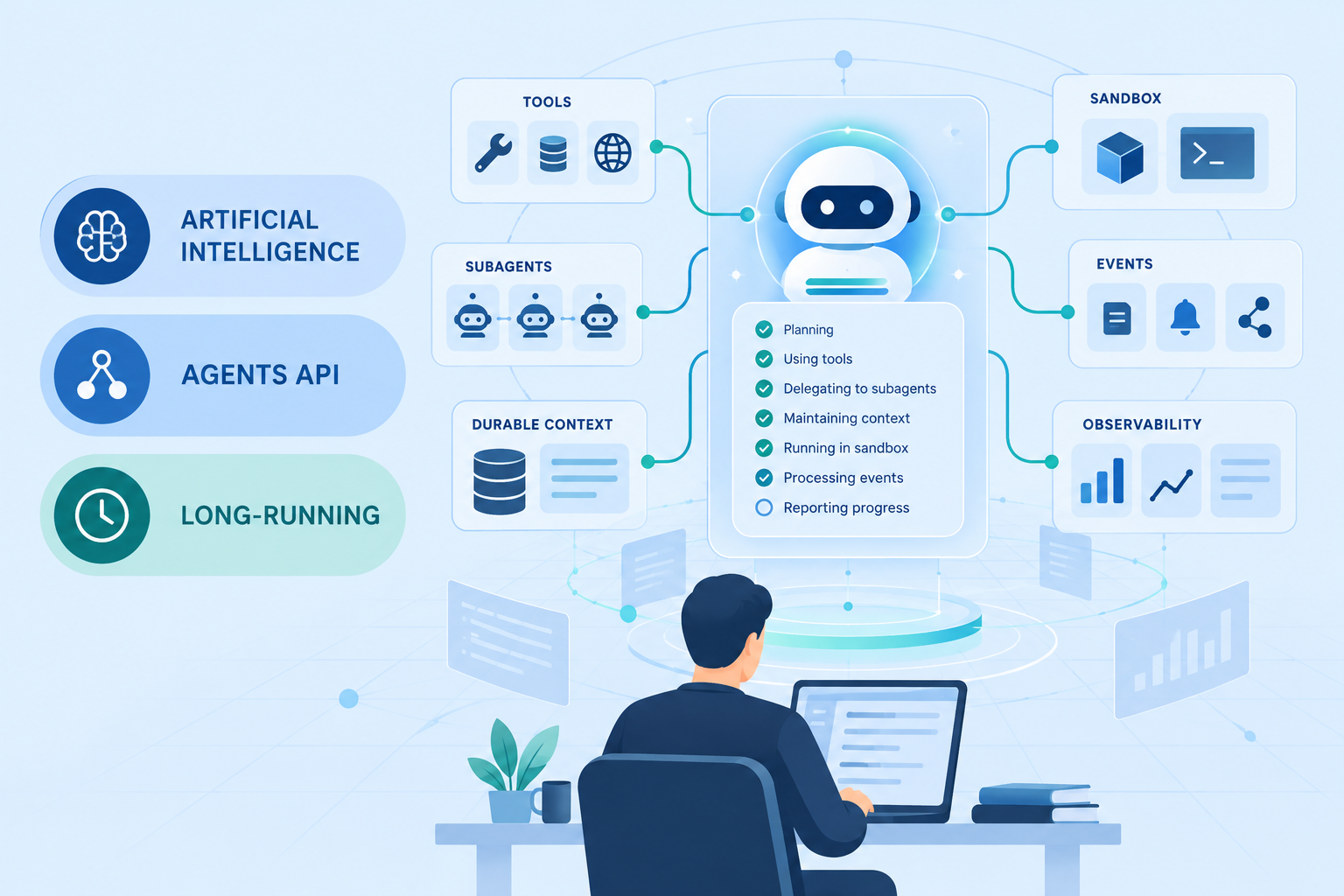
OpenAI’s Agents API brings the managed Codex harness to developers. It provisions an agent environment, maintains sessions, coordinates tools and subagents, and exposes events so applications can follow long-running work. The important architectural decision is not whether the service is capable; it is whether managed orchestration fits the workload, control model, and data requirements.
Three runtime choices
A managed Agents API suits long-running tasks where the provider should maintain orchestration and progress. An Agents SDK suits applications that want reusable agents and handoffs but retain the loop inside their own runtime. Direct model responses suit teams that need maximum control and are prepared to build state, tool execution, retries, and lifecycle management themselves.
Choose based on operational responsibility. If the differentiated value is the business workflow rather than orchestration infrastructure, a managed runtime can reduce undifferentiated work. If residency, custom scheduling, or tightly controlled execution dominates, a self-managed option may be necessary.
Model the session as a business resource
A session is a durable unit of agent work, not merely chat history. Give it an owner, purpose, retention policy, budget, and terminal states. Store the business correlation identifier alongside the agent session so support teams can connect a workflow outcome to its tools, approvals, artifacts, and events.
Define when a session can be continued, steered, paused, or abandoned. Orphaned sessions create cost and governance risk. Expiration and cleanup should be part of normal lifecycle management.
Constrain tools and environments
Tool design determines practical authority. Prefer narrow functions over generic credentials. Separate read, propose, and act operations, and require approval for material external changes. Validate arguments outside the model and return structured errors that allow safe recovery.
Choose an environment deliberately: hosted sandbox, self-hosted sandbox, or no sandbox. Treat files in the environment as governed data. Control ingress, egress, network access, secrets, and retention. A sandbox limits impact only when its permissions and connected tools are also limited.
Observe outcomes, not just tokens
Stream and store the events needed to understand progress without exposing unnecessary sensitive data. Useful measures include completion rate, tool failures, approval frequency, session duration, intervention rate, cost per successful outcome, and repeated planning loops. Trace model, instruction, skill, and tool versions so regressions can be reproduced.
Long-running tasks need explicit budgets: maximum duration, steps, tool calls, and spend. Budget exhaustion should produce a useful checkpoint and escalation rather than an abrupt, context-free failure.
Design failure and handoff
Classify retryable infrastructure failures separately from business ambiguity and policy blocks. For user input, provide the exact question and evidence gathered. For tool outages, retain a safe checkpoint and avoid duplicating side effects on resume. For policy violations, stop the affected action and preserve an audit trail.
Subagents should have clear scopes and a single accountable orchestrator. More agents do not automatically improve quality; they increase coordination and evaluation requirements. Add specialization only when it produces measurable gains.
The takeaway
A managed agent runtime is valuable when agent work outlives a request and needs durable sessions, tools, environments, progress events, and orchestration. Treat it as an operational platform choice. Define authority, lifecycle, budgets, observability, and failure behavior before handing it production work.
Sources
Build it with Cogniquaint experts
Cogniquaint’s in-house AI experts can work with product and engineering teams to select the right runtime, design least-privilege tools, build evaluations and approval paths, and operationalize long-running agents with measurable controls.
Work with Cogniquaint
Ready to elevate your operations with AI-powered insights?
Get in touch with us to build your next intelligent solution.