
ERP customization often begins with a reasonable exception and ends as an upgrade program. Code inserted into the core accumulates dependencies on internal tables, transaction behavior, and release-specific implementation details. When the platform changes, every modification becomes a test and remediation obligation.
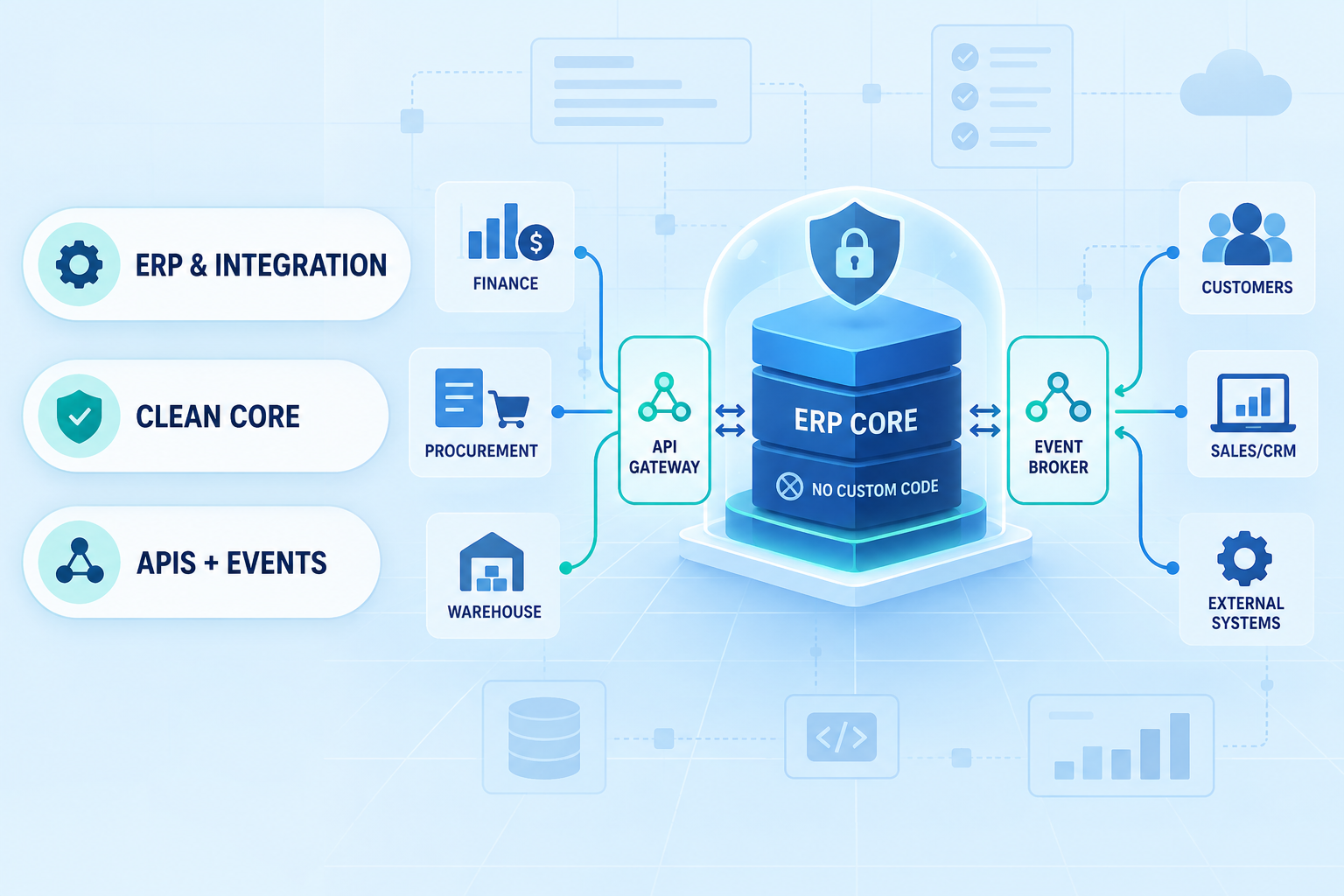
A clean-core integration strategy moves variation to governed extension surfaces: published APIs, business events, orchestration workflows, and external services. The objective is not zero customization. It is to keep the ERP product upgradeable while giving the business controlled ways to differentiate.
Separate commands, facts, and processes
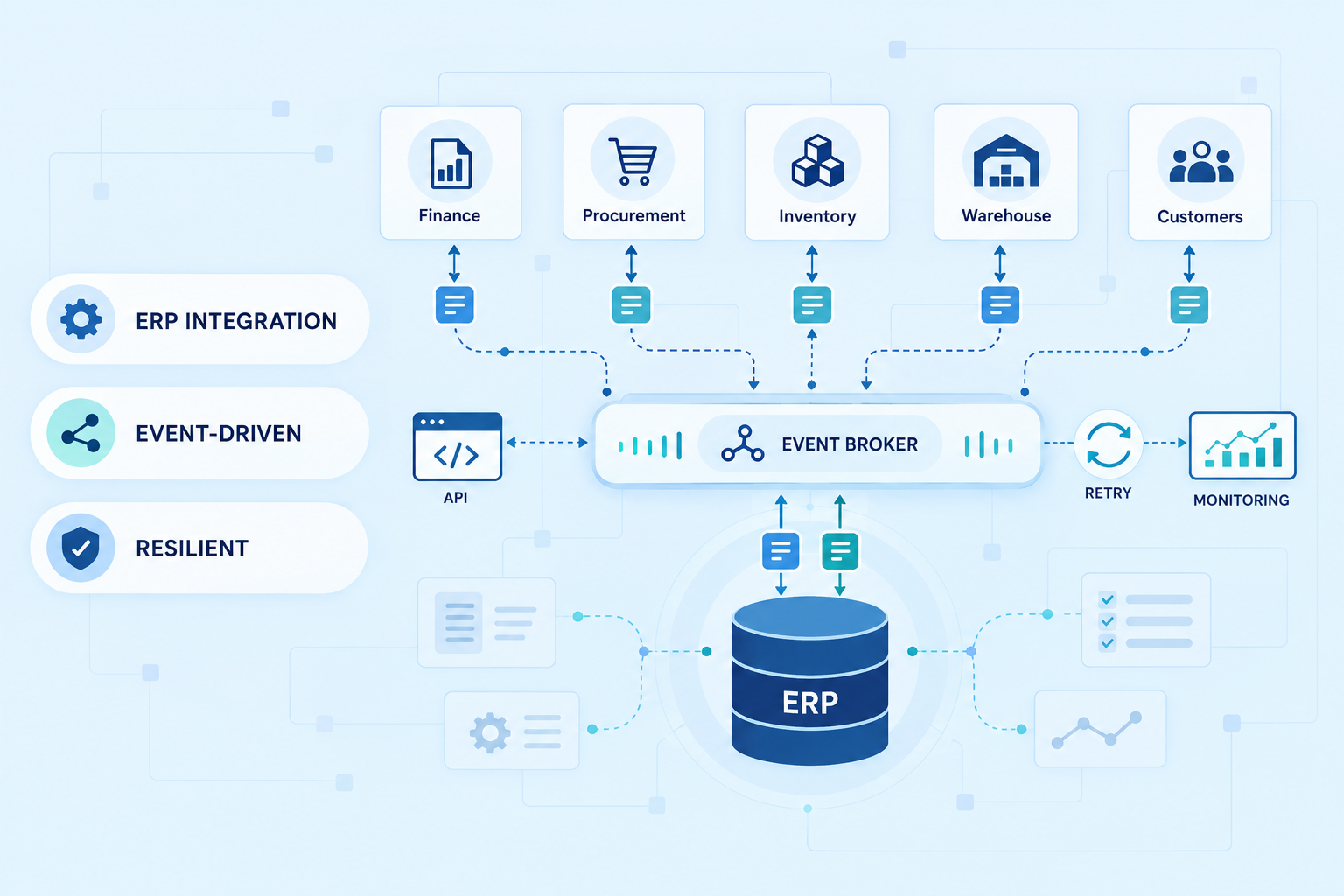
Use synchronous APIs for commands that need immediate validation and response, such as creating a requisition or checking customer eligibility. Use events for facts that have already occurred, such as PurchaseOrderApproved or GoodsReceived. Use orchestration for long-running processes with approvals, timeouts, compensations, and visible state.
This separation prevents an event bus from becoming a hidden command network and prevents APIs from carrying every asynchronous process. Batch exchange can remain appropriate for high-volume, non-urgent reconciliation. Select the style from the business interaction.
Protect the ERP contract
Consumers should depend on versioned public contracts, not internal tables or screen automation. Maintain an API and event catalog with owner, purpose, schema, sensitivity, service objective, and lifecycle. Prefer additive changes and provide parallel versions when a breaking migration is unavoidable.
Business events should describe stable domain facts. Include an event identifier, type, version, source, timestamp, correlation identifier, and business key. Keep regulated data out of the payload unless consumers genuinely need it.
Put custom logic in governed extensions
Extension services can implement organization-specific validation, enrichment, routing, and user experiences without changing ERP source code. They still need architecture discipline. Define identity, data access, deployment, observability, and ownership. A poorly governed external extension can be as fragile as an internal modification.
Microsoft’s account of the Dynamics 365 SaaS journey highlights model-driven extensibility and isolation as ways to preserve customer variation while keeping tenants on the same product version. That principle applies across ERP platforms: provide stable extension mechanisms and prevent one customization from destabilizing the core.
Design for asynchronous reality
Event delivery can be duplicated or delayed. Consumers must be idempotent and use business keys for irreversible actions. Apply transactional outbox patterns or platform equivalents so an ERP transaction and its event cannot silently diverge. Use dead-letter handling, bounded retries, and controlled replay.
Trace business outcomes across API gateways, brokers, orchestrators, and consumers. A process owner should be able to see why an order has not reached fulfillment without reading infrastructure logs.
Build an upgrade-safe roadmap
Inventory integrations and rank them by core coupling, business criticality, change frequency, and incident history. Begin with a brittle interface that has a clear contract and measurable pain. Replace direct database access with a published API or event, run both paths in parallel, reconcile results, and retire the old dependency.
Establish guardrails for new work: no direct writes to core tables, mandatory catalog registration, compatibility testing, least-privilege identities, correlation identifiers, and an owner for every interface. Track custom objects retired, upgrade test effort, failed messages, mean time to recovery, and time to onboard a new consumer.
The takeaway
Clean core is an operating discipline, not a one-time migration. Keep the ERP authoritative for business transactions, expose governed contracts, and place differentiation in extensions that can evolve independently. APIs, events, orchestration, and batch all remain useful when their roles are explicit.
Sources
- Microsoft: Integration architecture design
- Microsoft: Event-driven architecture style
- Microsoft: Dynamics 365 SaaS architecture journey
Build it with Cogniquaint experts
Cogniquaint’s ERP and integration experts can partner with application teams to inventory core customizations, define API and event contracts, build resilient extensions, and deliver a phased modernization roadmap without disrupting critical operations.
Work with Cogniquaint
Ready to elevate your operations with AI-powered insights?
Get in touch with us to build your next intelligent solution.