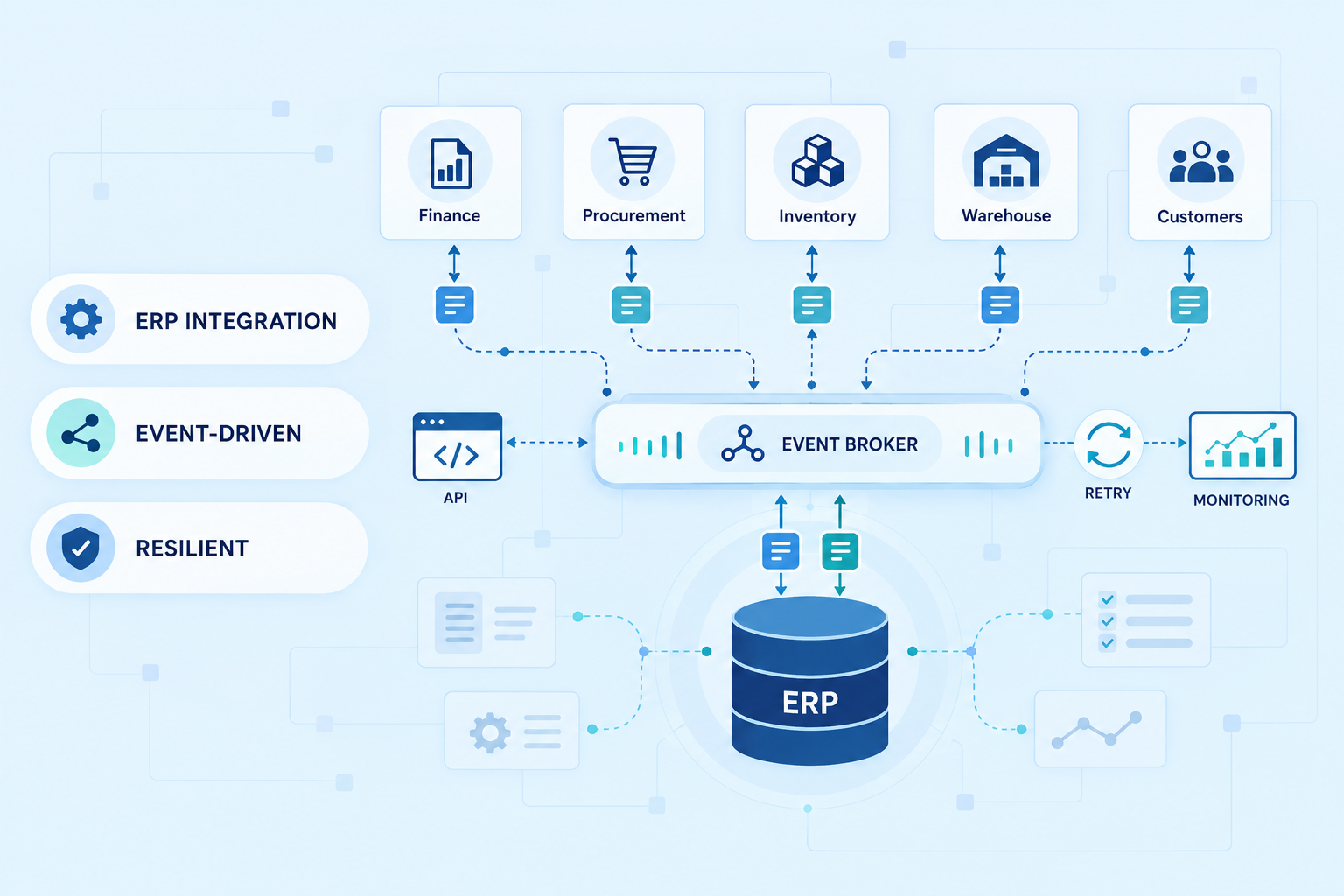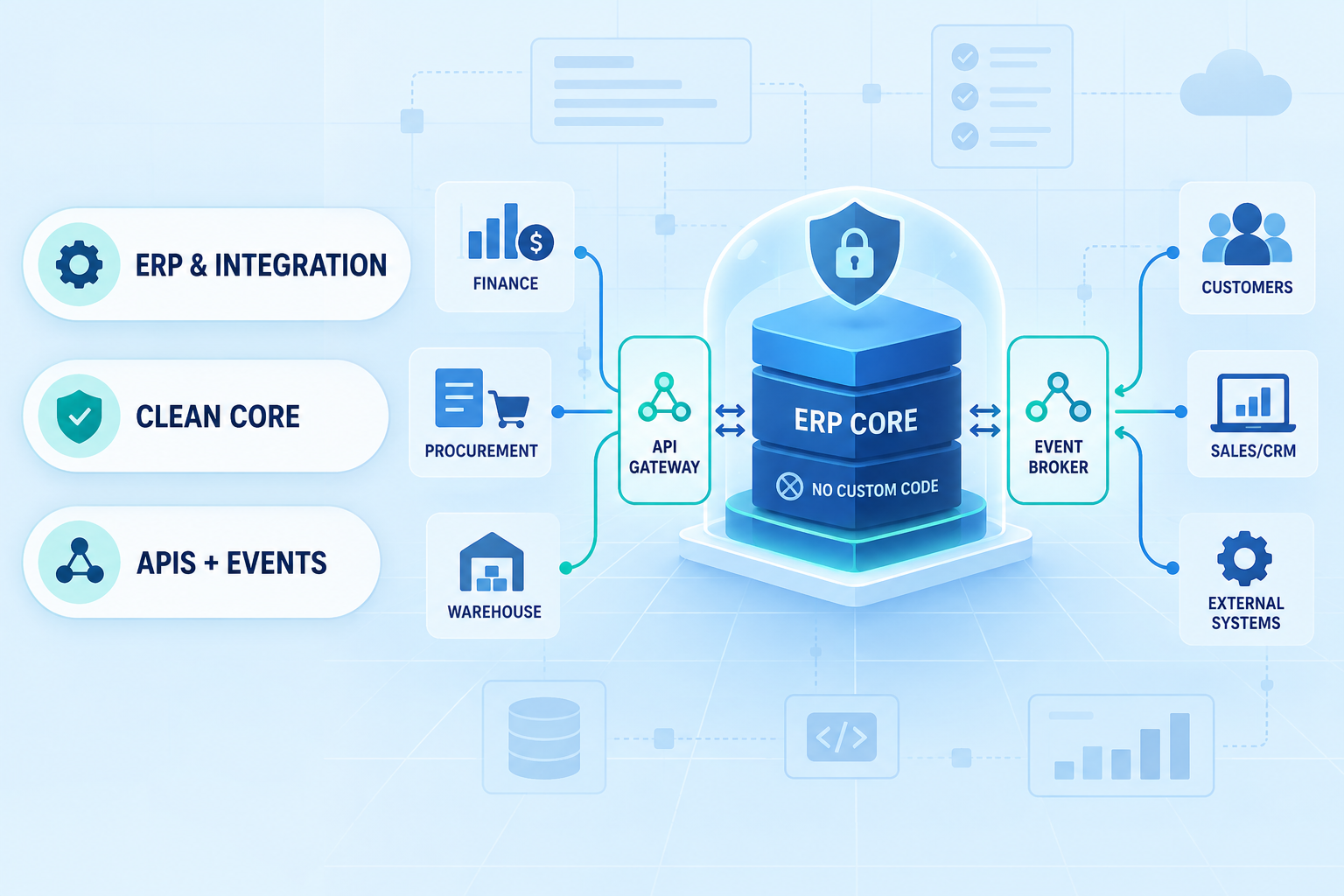


An integration dashboard can show every API as healthy while a purchase order remains stuck. Technical telemetry is necessary, but enterprise operations care about business outcomes: Was the order approved? Did the supplier receive it? Was the receipt matched to the invoice? Observability must connect system signals to the transaction people recognize.
Create one traceable business context
Assign a correlation identifier when the process begins and propagate it through the ERP, API gateway, broker, orchestrator, serverless functions, and downstream applications. Preserve the business key—such as purchase order or invoice number—under appropriate access controls. The correlation ID links technical telemetry; the business key helps authorized teams find the case.
Standardize an integration envelope containing event ID, type, version, source, timestamp, correlation ID, causation ID, tenant, and trace context. Avoid placing sensitive business data in headers or broadly visible logs.
Combine traces, metrics, logs, and process state
Distributed traces show the path and timing of one transaction. Metrics reveal system-wide patterns such as consumer lag, retries, dead-letter volume, and latency percentiles. Logs explain local decisions and errors. Process state records the business milestone.
OpenTelemetry provides vendor-neutral concepts for traces, metrics, and logs. Instrument integration components consistently, but also emit domain milestones such as OrderValidated, SupplierAccepted, GoodsReceived, and InvoicePosted.
Make asynchronous gaps visible
Event-driven systems contain waiting time that a synchronous trace may not naturally capture. Link producer and consumer spans using message trace context and record queue dwell time separately from processing time. Use causation identifiers when one event creates another.
Duplicate delivery and replay are normal operating conditions. Record original event ID, replay ID, attempt number, and idempotency outcome. Operators should be able to distinguish a recovered transaction from a duplicate business action.
Build a business-facing operations view
Create views such as “orders awaiting supplier acknowledgement,” “receipts not invoiced within target,” or “employee updates rejected by payroll.” Each case should expose the current milestone, responsible system, elapsed time, last successful step, retry status, and remediation owner.
Do not give every user access to raw payloads. Use role-based views, masking, retention controls, and audit trails. Observability data can contain commercially sensitive identifiers and personal information.
Define service objectives end to end
An API latency target does not describe the time required to complete an order-to-cash process. Define service-level objectives for important journeys, then allocate supporting objectives to integration components. Monitor both technical availability and percentage of business transactions completed within the expected window.
Test the dark paths
Exercise delayed events, unavailable consumers, schema errors, dead-letter recovery, replay, and partial downstream failure. Confirm that alerts identify the affected business cases and that recovery does not create duplicates. Observability is proven during failure, not by a green dashboard.
The takeaway
ERP integration observability should tell a coherent story from business intent to final outcome. Shared context, linked telemetry, domain milestones, and controlled operations views reduce diagnosis time and let technical and process owners work from the same evidence.
Sources
- Microsoft: Integration architecture design
- Microsoft: Event-driven architecture style
- OpenTelemetry: Observability primer
Build it with Cogniquaint experts
Cogniquaint’s ERP and integration experts can work with process owners and platform teams to define correlation standards, instrument interfaces, build business-journey dashboards, and test recovery across complex enterprise workflows.
Work with Cogniquaint
Ready to elevate your operations with AI-powered insights?
Get in touch with us to build your next intelligent solution.