
Long-running batch pipelines often fail for reasons that have little to do with transformation logic. A downstream API is rate limited, a quota becomes temporarily unavailable, or a shared service experiences an outage. The conventional response is blunt: fail the job, fix the dependency, and restart everything. For multi-hour data preparation and AI workloads, that can mean paying twice for work already completed.
Checkpoint-aware pause and resume introduces a more useful operational state between running and failed. Google Cloud has made pause/resume generally available for Dataflow batch jobs, including a pause-on-failure option that preserves completed work while workers are removed. The capability is not a substitute for reliable code, but it changes recovery economics for the right workloads.
What pause-on-failure actually does
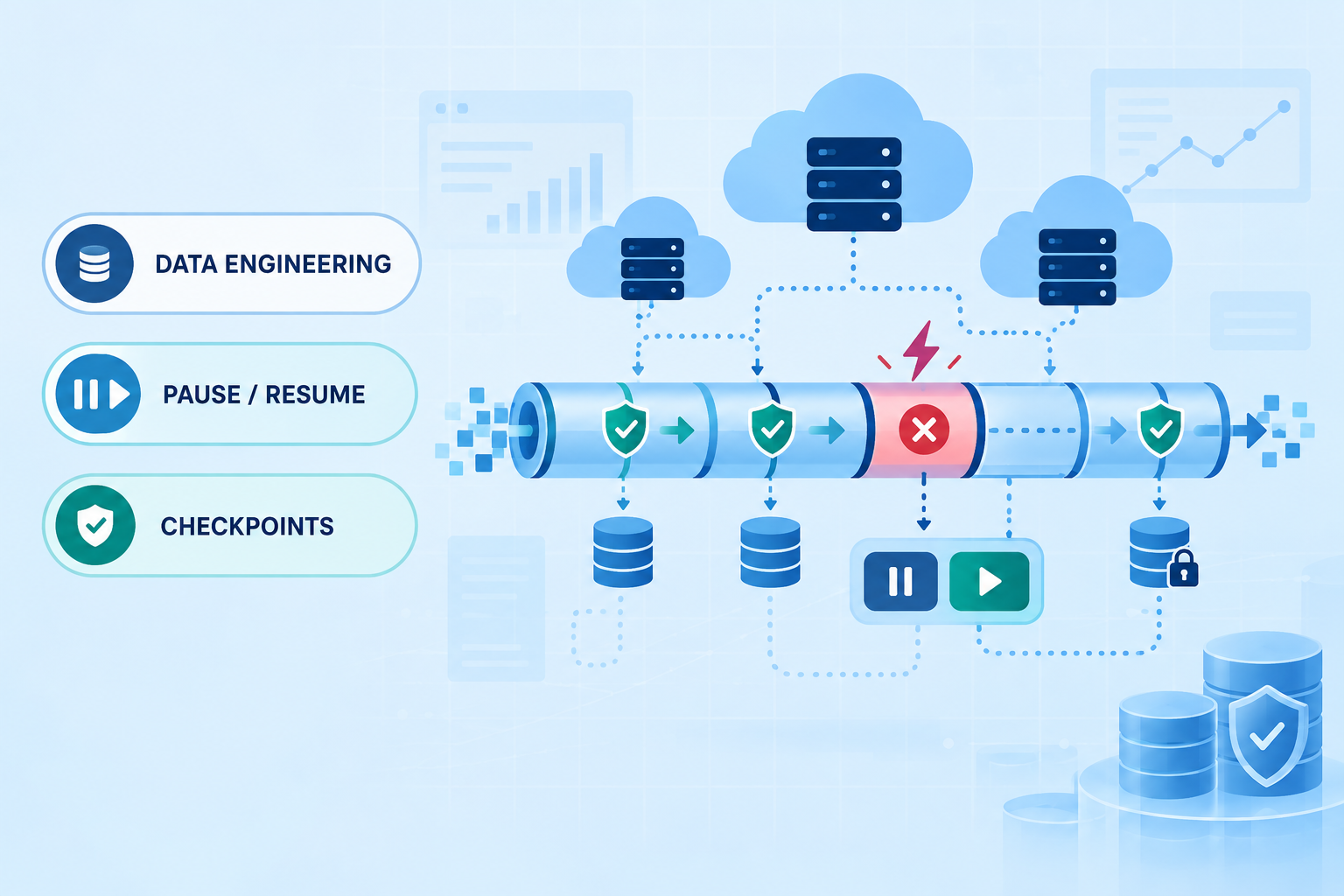
When enabled, the service can pause a batch job after a work item repeatedly fails. Completed work remains recorded through Dataflow Shuffle checkpoints. While the job is fully paused, worker virtual machines are removed and the archived shuffle state is retained. After the external issue is resolved, the job resumes without reprocessing stages or work items that had completed successfully. Work that was in progress at the pause boundary can be retried.
The feature is limited to batch jobs that use Dataflow Shuffle and explicitly enable the service option. It also has a bounded pause duration. Teams should treat those constraints as part of the pipeline contract, not discover them during an incident.
Where the pattern creates value
The best candidates combine high restart cost with recoverable external failures. Examples include large feature-generation runs, document processing, historical backfills, media transformation, and batch inference. If a six-hour pipeline fails during its final stage because a destination is unavailable, retaining five hours of completed work has a direct cost and recovery-time benefit.
Pause also provides a controlled response to temporary capacity pressure. Lower-priority work can release workers while preserving progress, allowing scarce quota or accelerators to serve urgent workloads. This requires priority classes and decision rules; otherwise operators simply move contention from infrastructure into an ad hoc queue.
Design the recovery workflow
First, classify failures. Deterministic data or code errors should not be retried indefinitely. Transient dependency failures, rate limits, and short maintenance windows are better pause candidates. Second, set a maximum pause duration aligned with the recovery objective. A paused job that silently expires is still a failed business process.
Third, monitor state transitions rather than only terminal failures. Alert on pausing, paused duration, retained shuffle cost, and approaching cancellation. The incident record should include the failing work item, dependency, last successful checkpoint, owner, and exact resume criteria.
Finally, test recovery. Inject an external failure, confirm workers are released, restore the dependency, resume the job, and reconcile outputs. Verify that sinks are idempotent and that reprocessed in-flight work cannot create duplicate side effects.
Operational guardrails
Do not delete temporary data while a job is paused. Keep permissions for pause and resume narrow, because these controls affect both availability and spend. Define who can cancel a paused job when business value no longer justifies retaining state. Track recovered compute time as an outcome, but also investigate recurring pauses; a recovery mechanism must not normalize an unreliable dependency.
The takeaway
Pause and resume gives data teams a third option between endless retries and full restart. Used with failure classification, checkpoint-aware sinks, clear ownership, and rehearsed recovery, it can reduce waste and shorten restoration for expensive batch workloads. The real improvement is not the button—it is an operating model that preserves completed work while teams correct temporary conditions.
Sources
- Google Cloud: New Dataflow features for large-scale AI workloads
- Google Cloud documentation: Pause a Dataflow job
- Google Cloud documentation: Dataflow service options
Build it with Cogniquaint experts
Cogniquaint’s in-house data engineering experts work alongside platform teams to identify restart-heavy workloads, design checkpoint and idempotency controls, implement observability, and validate recovery through a production-ready pilot.
Work with Cogniquaint
Ready to elevate your operations with AI-powered insights?
Get in touch with us to build your next intelligent solution.